• Skip to main content
  • Skip to primary sidebar
Listen to the Latest Podcast EpisodeAnd We’re Back! Introducing: Diabetes Digital
Food Heaven Made Easy

Food Heaven Made Easy

Black Registered Dietitian Nutritionists | Intuitive Eating Dietitians

  • About
  • Press
    • Diabetes Digital
    • Start Here
    • Podcast
      • Hookup Codes
    • Work With Us
    • Resources
      • Recipes
      • Blog
      • Cookbook
      • Books We Love
    Looking for nutrition counseling with expert registered dietitians?
    Get Started

    Wendy

    6 Balanced Snacks to Eat After a Workout

    April 11, 2019 by Wendy Leave a Comment

    Disclosure: This post was made in partnership with California Almonds. Thank you for supporting the growth of Food Heaven!
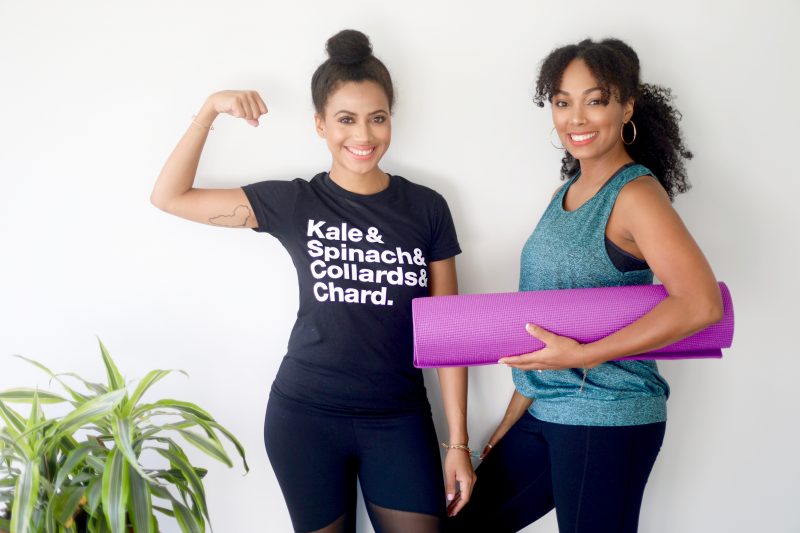
    Have you ever left your workout feeling like you’re on top of the world…and then those hunger pangs start kicking in? Your stomach is still doing jumping jacks, you feel light headed, and you’re ready to eat everything in sight. Yeah, we know that feeling. Which is why we’re bringing you this article on 6 balanced snacks you can eat after your workout session!

    When thinking about post-workout snacks, aim for a balance of protein and carbohydrates. You want to repair those muscles, while also getting a boost of quick energy into your system.

    For those of you wondering, well how often should I be working out? We generally recommend about 150 minutes of moderate cardio per week and 2 days of strength training. Cardio would be things like running, zumba, and dance, while strength training would be any weight lifting, working with resistance bands, or squats. We understand that life gets in the way though, and so it’s important to set realistic goals when thinking about exercise.

    It’s also important that you to find activities that you love and find pleasure in doing. Try out a variety of different exercises, classes, videos, or activities and find what speaks to you most!

    Alright, ready to workout? Let’s talk about what you’ll be fueling up with once you’re done.

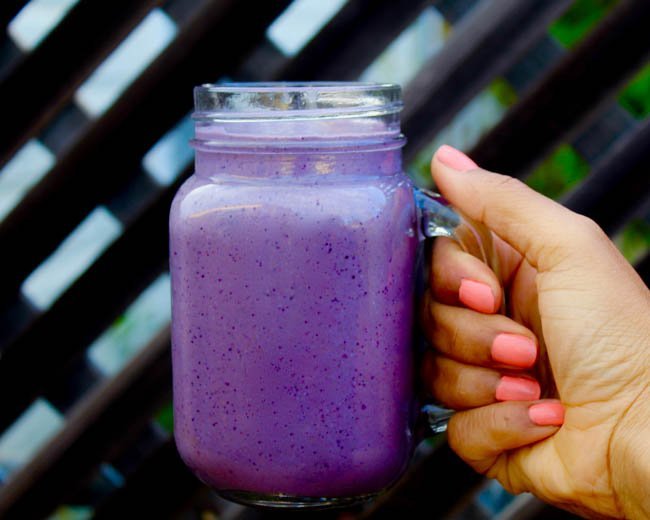
    1. Nourishing Post-Workout Smoothie:

    Before you start working out, take 5 minutes to blend up some fruit, almonds, and your favorite liquid base. Aim to prepare the smoothie right before you workout, so it’s not sitting out for too long. I typically prepare mine with 1 cup of frozen berries, ¼ cup of almonds, and use 2 cups of soy milk as my liquid base. This is one of my favorite post-workout snacks because it provides a great balance of protein, fat, and carbohydrate. Sometimes I may add chia seeds or flax seeds for additional fiber and protein!
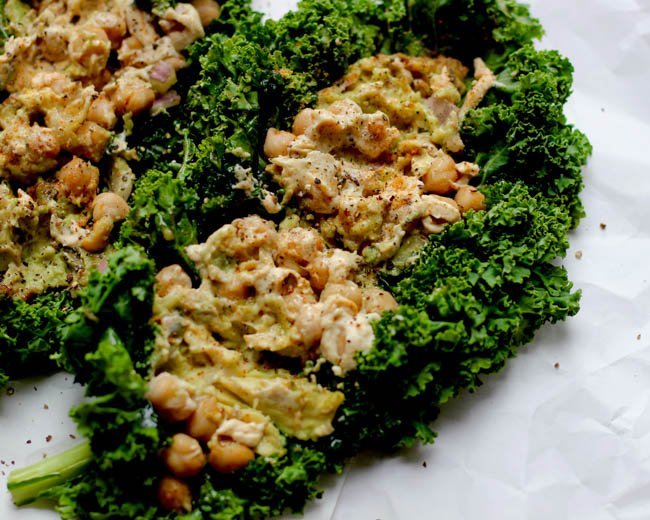
    2. Tuna Kale Wraps:

    These wraps take a few minutes to whip up, and you can incorporate them as part of your meal prep routine. Grab 2 large kale leaves, and stuff them with 2 ounces of tuna and ¼ cup of hummus or ¼ cup of your favorite beans. Season with your favorite spices and enjoy! Kale is packed with vitamins A, C, and K and is also a great source of iron, folate, B vitamins, calcium, manganese, and fiber. Consumption of dark, leafy greens (like kale) has also been shown to lower the risk of cardiovascular disease due to its high antioxidant content and anti-inflammatory function. Enjoying your greens in between meals is a great way to meet the recommended 3 cups of vegetables per day. 
     

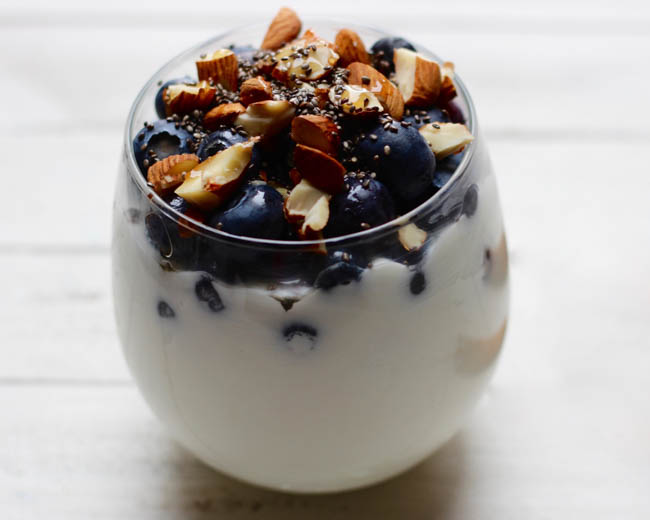
    3. Quick and Easy Parfait:

    This parfait takes less than 5 minutes to prepare, and to make your life easier, you can do all the pre-rinsing and chopping at the start of your week to save time. Add 1 cup of plain Greek yogurt to a to-go cup, and layer with ½ cup of blueberries, ¼ cup of chopped almonds, chia seeds, and a drizzle of maple syrup. The almonds alone in this nutrient-packed snack packs 6 grams of protein and 4 grams of fiber!
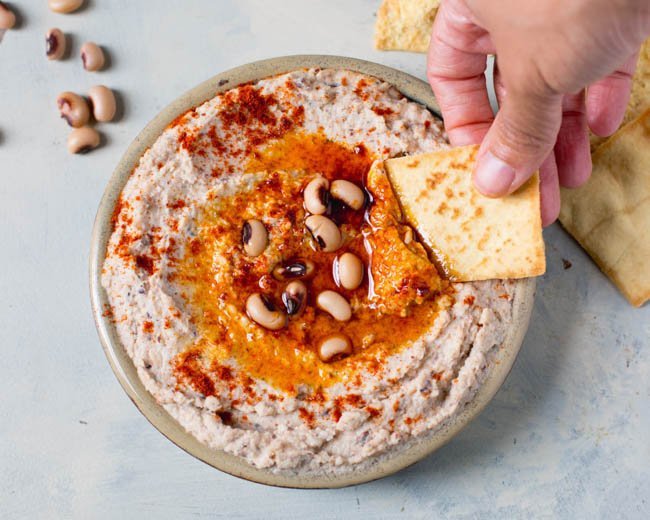
    4. Hummus w/ pita chips:

    Hummus is a delicious way to pack in that protein and fiber after your workout. You can either purchase pre-made hummus or make your own! If you decide to whip it up yourself, the best part is that you can get creative with how you make it. One of our favorite renditions is this black eyed pea hummus. Simply blend the black eyed peas, tahini, lemon juice, garlic, water, and olive oil until smooth. Add your favorite spices and enjoy with pita chips!
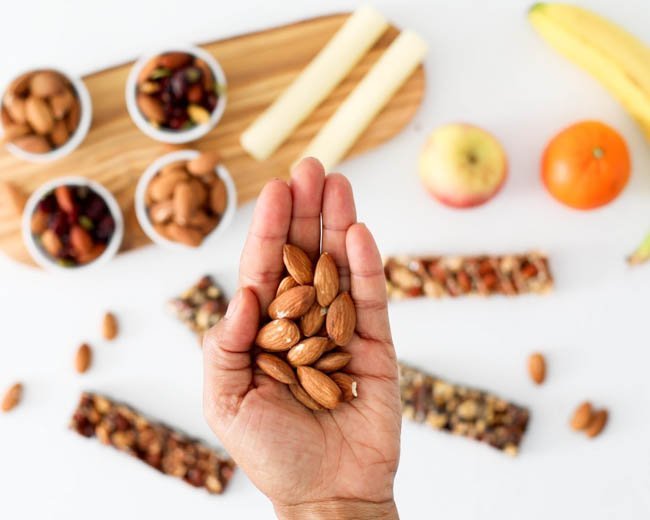
    5. A handful of almonds:

    Nothing is easier than packing up a handful of almonds to take with you to your workout. This is a straight-forward, no fuss snack that’s satisfying and nutritious. Almonds are jam-packed with antioxidants, which help protect the body against oxidative stress (the kind that can cause damage molecules in your cells and contribute to inflammation and disease). You can also pair them with your favorite grab-and-go fruit, which brings me to my next snack…
    6. Easy Banana Split:

    This is a really fun and quick snack that you can pack up and enjoy with a spoon. Simply slice a banana, and add dark chocolate chunks, chopped almonds, almond butter, and chia seeds! It’s perfect for those of you who have a sweet tooth, but don’t want that sugar crash a couple hours later. Dark chocolate is rich in polyphenols, flavanols, catechins, and other powerful antioxidants. Some studies have even shown that the flavanols in dark chocolate can improve circulation and may help with blood pressure control. Feel free to customize with your favorite fruit!

    Okay, so now that we have our snacks ready to go, who’s ready to workout? Let us know in the comments below what your favorite post-workout snacks are! Talk soon, xo

    Filed Under: Articles

    Vegetarian Carbonara Pasta w/ Roasted Asparagus

    April 5, 2019 by Wendy Leave a Comment

    Disclosure: This post is sponsored by Barilla. Thank you for supporting our work here at Food Heaven!

    There are only two vegetables that I don’t like. The first is eggplant. The second is mushrooms. No matter how hard I try, I can’t get into them. Friends say I am cooking them wrong. That the texture shouldn’t be “slimy” if you are “doing it right.”

    But it doesn’t matter. I tried, tried, and tried again. It’s still a no.

    Because of this fact, when Barilla(R) (a maker of pasta) asked us to create a Carbonara pasta recipe in celebration of Carbonara Day on April 6, I had to put my creative cap on… tight.

    Why? Carbonara is an Italian pasta dish from Rome made with egg, hard cheese and bacon. Obviously, bacon is not my jam (hence the plant-powered mission behind this platform). The real problem, though, is that most vegetarian Carbonara dishes replace the bacon with mushrooms. Sadly, not happening.

    So, what does a mushroom-hating vegetarian girl like me do in lieu of bacon and mushrooms? ASPARAGUS. Duh.

    It’s crunchy, green, delicious, & nutritious — the perfect Carbonara accent vegetable.
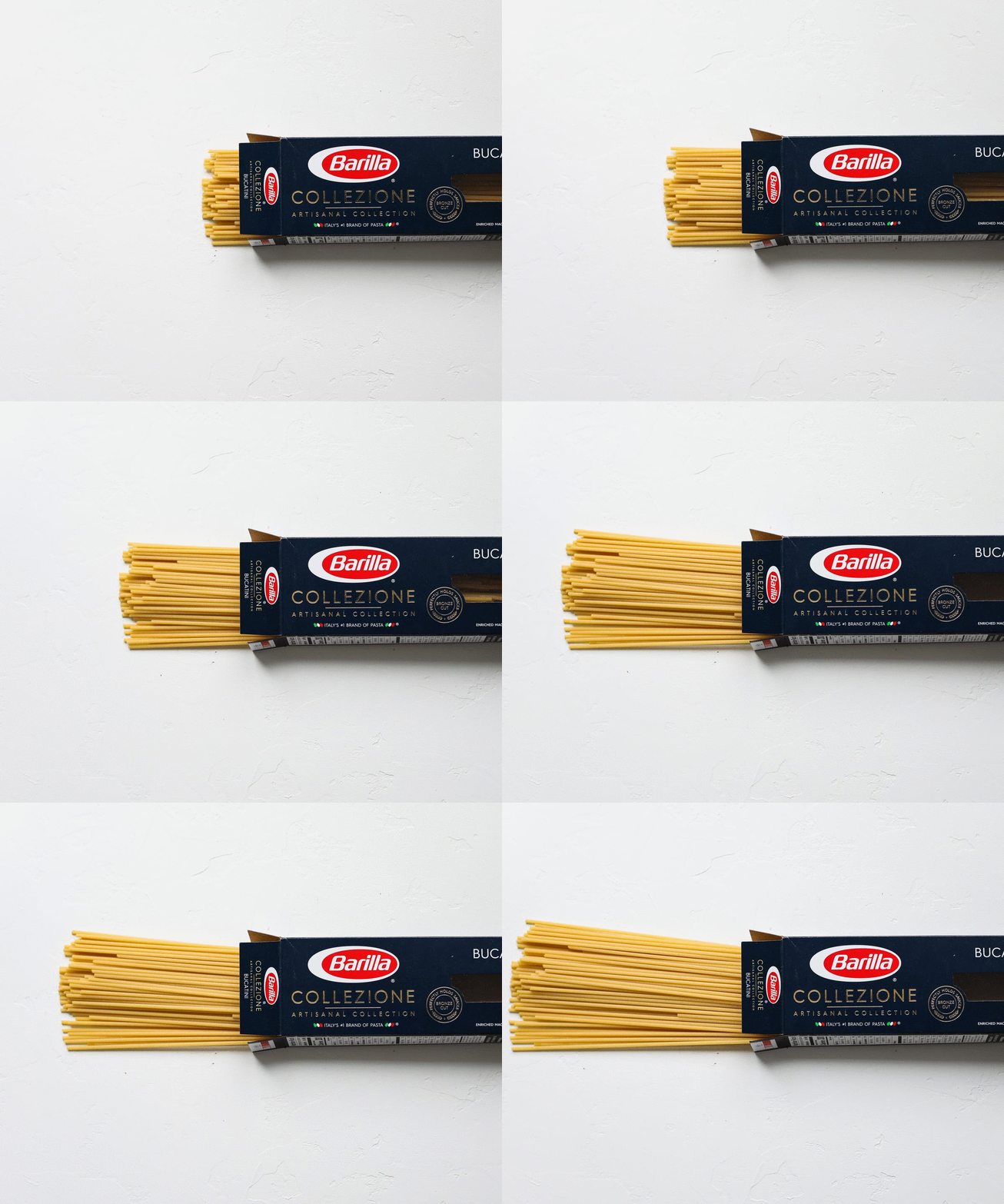
    Without further ado, we present An Egg-Free Vegetarian Carbonara Pasta w/ Roasted Asparagus using Barilla Collezione Bucatini. And I have to say, I kind of agree with Bon Appetit’s statement that Bucatini is “the best long pasta that there ever was or will be”.  When cooked al dente, it offers the perfect chewy texture that elevates any dish tenfold. BTW, this recipe is SUPER simple to make. But enough with the talking. Ready to eat more pasta?

    Here’s what you do: Start by soaking 1 cup of cashews in 2 cups of water for 1 hour.

    Preheat the oven to 415F, then lay asparagus on a baking sheet. Drizzle 1 teaspoon of olive oil onto the asparagus and top with salt and pepper. Roast for about 10 minutes or until the tops of asparagus start to crisp.

    Next, we’re going to cook the pasta. Bring 4-6 quarts of water to a boil. Add salt to taste, then add the pasta to boiling water. For authentic “al dente” pasta, boil for 7 minutes, stirring occasionally. For more tender pasta boil an additional minute.

    While the pasta is boiling, get out a pan and sauté the chopped onions in 2 teaspoons of olive oil over medium heat for 1-2 minutes or until fragrant. Add the chopped garlic and cook for another 1-2 minutes, continue to stir.

    Once the cashews are done soaking, add 1 cup of cashews and 1 cup of soaking water in a high-speed blender or food processor. Add the cooked onions, garlic and almond milk and pulse/blend until creamy. Remove the sauce from the food processor and mix with the cooked pasta. Squeeze the juice of ½ lemon on top and stir. Then sprinkle in parmesan cheese or nutritional yeast, and pepper and onion powder.

    Next, chop half of the cooked asparagus into ½-inch pieces. Mix throughout pasta. Serve the other half of the cooked asparagus as a side. Lastly, if you want to add basil, chop it now then sprinkle on top. Enjoy!

    Now it’s your turn. Join us in celebrating Carbonara Day on April 6 by sharing your favorite version of the dish on social the hashtag #CarbonaraChallenge. Do you think you’ll give this recipe a try? Let us know in the comments below! Until next time <3

    Print
    Egg-Free Vegetarian Carbonara Pasta Roasted with Asparagus
    Ingredients
    • 1 cup of cashews
    • 1-2 cups of water
    • 10 small asparagus
    • ½ box of Barilla Collezione Bucatini pasta
    • 3 teaspoons of olive oil, divided
    • Salt to taste
    • 1 cup chopped yellow onion
    • 3 cloves of chopped garlic
    • ½ cup of unsweetened almond milk
    • ½ teaspoon of fresh cracked pepper
    • 1 teaspoon of onion powder
    • Juice of 1 lemon
    • 2 tablespoons of parmesan cheese or nutrition yeast for a vegan version
    • Optional: basil
    Instructions
    1. Start by soaking 1 cup of cashews in 2 cups of water for 1 hour.
    2. Preheat the oven to 415F, then lay asparagus on a baking sheet.
    3. Drizzle 1 teaspoon of olive oil onto the asparagus and top with salt and pepper.
    4. Roast for about 10 minutes or until the tops of asparagus start to crisp.Next we’re going to cook the pasta.
    5. Bring 4-6 quarts of water to a boil. Add salt to taste, then add the pasta to boiling water.
    6. For authentic “al dente” pasta, boil for 7 minutes, stirring occasionally. For more tender pasta boil an additional minute.
    7. While the pasta is boiling, get out a pan and sauté the chopped onions in 2 teaspoons of olive oil over medium heat for 1-2 minutes or until fragrant.
    8. Add the chopped garlic and cook for another 1-2 minutes, continue to stir. Once the cashews are done soaking, add 1 cup of cashews and 1 cup of soaking water in a high-speed blender or food processor.
    9. Add the cooked onions, garlic and almond milk and pulse/blend until creamy. Remove the sauce from the food processor and mix with the cooked pasta. Squeeze the juice of ½ lemon on top and stir.
    10. Then sprinkle in parmesan cheese or nutritional yeast, and pepper and onion powder.
    11. Next, chop half of the cooked asparagus into ½-inch pieces.
    12. Mix throughout pasta. Serve the other half of the cooked asparagus as a side.
    13. Lastly, if you want to add basil, chop it now then sprinkle on top.

    Filed Under: Main Courses, Recipes

    Clearing Up Confusion About Probiotic Supplements

    March 14, 2019 by Wendy Leave a Comment

    Disclaimer: This post is sponsored by Mycrobiome. Thank you for supporting the work we’re doing here at Food Heaven!

    Almost every day, we hear questions like: What exactly do probiotic pills do? How long do I need to take them? Can’t I get probiotics from food?

    We get it. These live microorganisms are confusing, partly because we’ve been told bacteria is inherently bad. Of course, this couldn’t be further from the truth. There is an emerging body of research that suggests probiotics may be beneficial for supporting the microbiome, which is involved with everything from GI disorders to mood symptoms related to stress and anxiety. Below, we’ll give you the full scoop on probiotics and whether or not they’re right for you:

    Head on over to mindbodygreen right now to read the full article on Most Of Us Misunderstand Probiotic Supplements. Here Are 3 Things To Clear That Up

    Filed Under: Articles

    Crispy Baked Falafel

    March 14, 2019 by Wendy 6 Comments

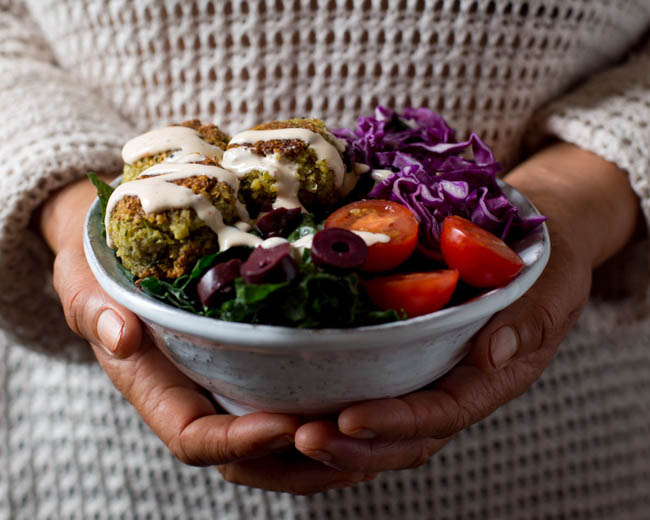
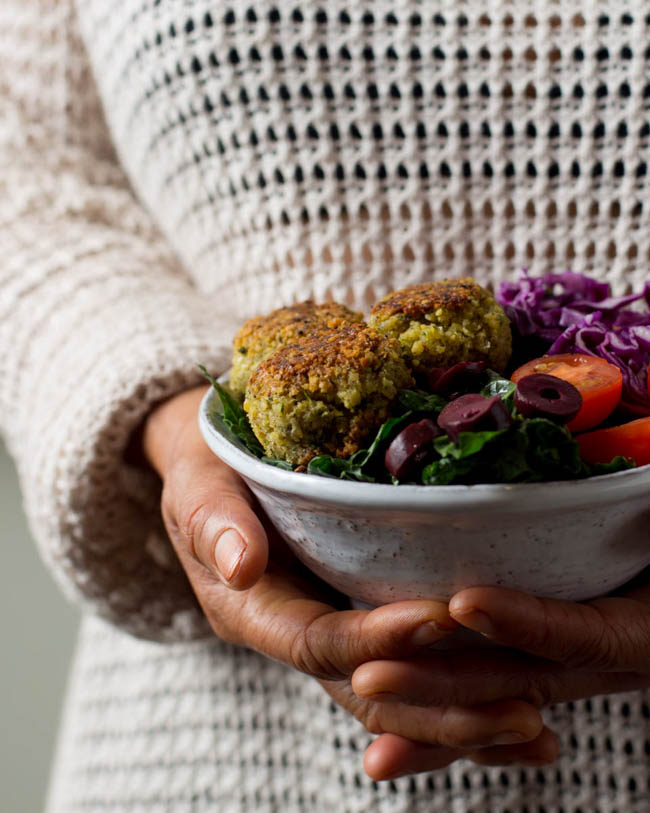
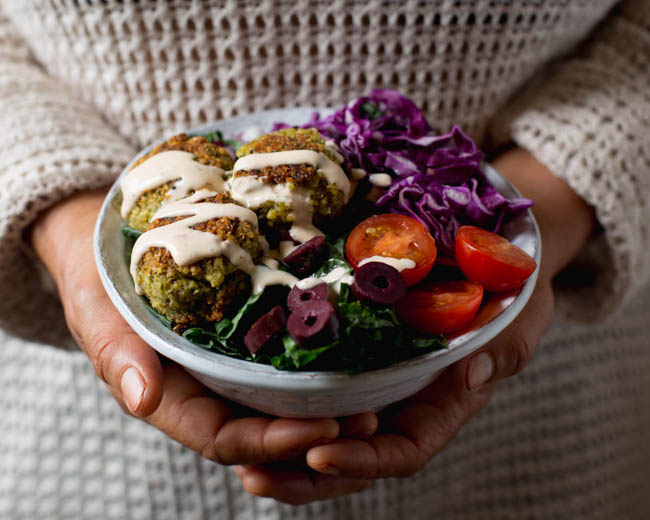
    This week we have this delicious baked Crispy Falafel recipe for you. Falafels are packed with flavor and crunch, and I love that you can add them to a salad or pita bread for a complete meal. This alternative uses a combination of pan-frying and baking, and so we’re not using all of the oil that the traditional deep frying method does. 

    The result is a crispy on the outside, tender on the inside, baked falafel recipe. I kept it very straightforward with the directions- you will be pulsing most of your ingredients, forming balls with your hands, and then getting to work on the stove! 

    Falafel is made primarily with chickpeas as the base.  Chickpeas are super versatile and delicious.  They are an excellent source of protein, with 15 grams of protein in just one cup of cooked chickpeas.  They are also loaded with iron, folate, and manganese, minerals that will help keep you energized and your body functioning the way that it should!

    Let’s get started with this recipe, shall we? Preheat the oven to 400F. Once the chickpeas are done soaking, drain them and rinse with fresh water. Add the soaked chickpeas, parsley, onion, garlic, spices, pepper and salt to a food processor. Pulse a few times, until you have a consistent, coarse texture. 

    Create 10-12 small falafel balls with your hands. In a medium pan, heat the vegetable oil on the stovetop, and add the falafel balls. I recommend you do this in 2 batches. Cook the falafel balls in the oil for 2 minutes on each side, using a spatula to carefully flip over. Once done, add them to a parchment paper-lined baking dish. Once all the falafels are cooked on the pan and added to the baking dish, drizzle the remaining oil from the pan onto the falafels, and bake for 20 minutes or until browned and crisp. Flip halfway with a spatula. 

    Enjoy with pita, greens, rice, and/or your favorite pairings! Store leftovers in an airtight container in the fridge, and reheat in the oven until fully heated and crisp on the outside. 

    We hope you give these a try! Let us know in the comments below how this recipe turns out for you.

    Print
    Crispy Baked Falafel


    Servings: 10 falafel balls
    Ingredients
    • 1 cup dried chickpeas, soaked in water overnight
    • 1/2 cup fresh parsley
    • 1/2 medium onion chopped
    • 3 garlic cloves chopped
    • 1 teaspoon cumin
    • 1 teaspoon coriander
    • 1/4 teaspoon black pepper
    • 1 teaspoon salt
    • 1/4 cup vegetable oil
    Instructions
    1. Preheat the oven to 400F.

    2. Once the chickpeas are done soaking, drain them and rinse with fresh water.

    3. Add the soaked chickpeas, parsley, onion, garlic, spices, pepper and salt to a food processor. Pulse a few times, until you have a consistent, coarse texture. 

    4. Create 10-12 small falafel balls with your hands. 

    5. In a medium pan, heat the vegetable oil on the stovetop, and add the falafel balls. I recommend you do this in 2 batches. 

    6. Cook the falafel balls in the oil for 2 minutes on each side, using a spatula to carefully flip over. Once done, add them to a parchment paper-lined baking dish.

    7. Once all the falafels are cooked on the pan and added to the baking dish, drizzle the remaining oil from the pan onto the falafels, and bake for 20 minutes or until browned and crisp. Flip halfway with a spatula. 

    8. Enjoy with pita, greens, rice, or your favorite pairings! 

    Recipe Notes

    You can store leftover falafels in an airtight container for up to 5 days. Reheat in the oven until fully crisp, and enjoy! 

    Filed Under: Main Courses

    Black & Brown Skincare w/ Dr. Michelle Henry

    March 7, 2019 by Wendy 3 Comments

    Did you know that you SHOULDN’T use coconut oil on your face?

    I bet your mind is blown.

    Because so many of us use coconut oil on our face and body every day. But this week’s podcast guest, board-certified dermatological surgeon, Dr. Michelle Henry, says that coconut oil on your skin is a no-go.

    Dr. Henrry explains: “Whenever a patient comes in with a ton of blackheads, I always ask them: are you using coconut oil?”

    In this week’s episode, we talk about ALL things black and brown skincare, including: what’s the best type of oil for your skin, how many times per day you should be washing your face, what the science actually says about nutrition & acne, and whether or not a washcloth is truly needed (Dr. Henry says this may be more of a cultural question than a scientific one…Ha!)

    And we know what you’re thinking, you don’t need to worry about skin health because “black don’t crack” and “Angela Basset”. But the truth is, there are PROS and CONS to having darker skin.

    This episode completely changes our skincare routines, and you NEED. TO. LISTEN.

    Black & Brown Skincare w/ Dr. Michelle Henry

    In this episode, we’ll talk about:

    • Which foods keep our skin flourishing
    • The best products to help maintain healthy skin
    • What inspired Dr. Michelle Henry to get into the field of dermatology
    • Nutrition advice for people with skin issues
    • How we can prep our skin for the cooler and warmer months
    • & MORE! 

    Resources: 

    • Dr. Michelle Henry’s Website
    • Facebook
    • Instagram
    • Twitter
    • Dr. Michelle’s top 5 skin products right now: Cleanser:  Mario Badescu Foaming Glycolic Acid | Toner: Biologique Recherché P50 lotion | Moisturizer: Skin Better Science Trio moisturizer | Vitamin C Serum: Clinique Fresh Pressed | Retinol: Skin Medica Retinol 0.025

    SHOUT OUT TO OUR PODCAST SPONSORS:

    Want counseling but have trouble finding someone who can relate? Connect with over 3000 licensed therapists on your own time and at your own pace. Visit BetterHelp.com/HEAVEN for 10% off BetterHelp’s affordable counseling services.

    Looking to take the guesswork out of dinner? Green Chef is a USDA Certified Organic company that makes eating well easy and affordable with plans to fit every kind of lifestyle. Visit Greenchef.us/FOODHEAVEN for $50 off your first box of Green Chef’s wholesome meals!

    Can you do us a huge favor?

    If you enjoyed this episode about Black & Brown Skincare, please do us a huge favor and leave us a review on iTunes ….right now. The more reviews we get, the higher we are ranked in iTunes, which means we reach more people!

    Become a podcast sponsor:

    Our podcast reaches thousands of engaged listeners each week. If you are a brand interested in becoming a sponsor, contact us to learn more about our affordable rates.

    Connect with us online:

    • Instagram @foodheaven
    • Twitter @foodheavenshow
    • Facebook @foodheavenmadeeasy
    • Pinterest @foodheavenmadeeasy

    Our podcast is released every week. In each episode, we cover tips and tricks for making lifelong sustainable healthy living changes to upgrade your diet and health. We also interview leading experts in the field of health and nutrition. We hope you enjoyed this episode, and we’ll catch you next time!

    Filed Under: Podcast

    What is a Registered Dietitian Nutritionist?

    March 1, 2019 by Wendy Leave a Comment

    wendy and jess of food heaven

    One of the questions we get asked about frequently is what exactly is a Registered Dietitian and what do we actually do?

    If you have been following us for some time, then you know that we are both Registered Dietitians. While we have a post on how to become a Registered Dietitian Nutritionist (RD/RDN) that touches briefly on what we do, we thought it would be a good idea to break it down even further. So, let’s get started.

    “So… what is a Registered Dietitian?”

    Registered Dietitians (RDs), also known as Registered Dietitian Nutritionists (try saying that 3 times fast), are skilled health care professionals who are experts in food and nutrition. They help people develop practical solutions to make positive lifestyle changes to improve their diet and health.

    “My sister’s best friend is a “Nutritionist.” That’s what you are right?”

    Wrong. Think about it like this: dietitians can call themselves nutritionists, but nutritionists can’t call themselves dietitians. RDs have to undergo extensive training that includes taking courses in food and nutrition, completing 1200 hours of supervised practice, and passing the national RD exam. Practicing RDs must also complete a minimum of 75 hours of continuing education with at least 1 hour of Ethics training every 5 years in order to maintain the credential. The RD/RDN credential is the only accepted dietetic credential for those wanting to practice in clinical settings (think hospitals, clinics, and doctor offices) and is the most widely accepted dietetic credential. Approximately half of all RDs hold graduate degrees and many also have certifications in specialized fields which include nutrition support, sports nutrition, pediatrics, renal nutrition, oncology, or gerontology.

    Professionals can call themselves “nutritionists” without being required to have any formal education or certification. They may have studied nutrition in college or have an advanced degree (M.S, MPH, or Ph.D.) in nutrition, taken an online certification course in nutrition, or have no formal education in nutrition at all. The term “nutritionist” is not regulated or protected by law which allows practically anyone to consider themselves one.

    “Does an RD just work in hospitals creating meal plans?”

    While it seems that many people have no idea what we do, a lot of people think that all RDs do is generate meal plans or work in a kitchen. However, being an RD is so much more than that! This profession is super rewarding and has almost limitless career possibilities. The majority of dietitians work in the treatment and prevention of disease in healthcare settings (hospitals, private practice, other healthcare facilities) providing medical nutrition therapy (MNT) as part of medical teams. Through MNT, RDs review their patients eating habits and lifestyle and provide a thorough assessment of their nutritional status. This allows them to develop a personalized nutrition treatment plan that is unique and specialized to their individual needs.

    The cool thing is, dietitians have expanded reach beyond hospital and clinical settings and can be found in community and public health settings, academia, research, private counseling, corporate wellness, culinary nutrition, nutrition & health policy, health journalism, food photography, grocery stores, business, sports nutrition, and MORE. Many dietitians also have their own blogs, websites, and social media channels (like us!). Check out our Dietitian Spotlight to find out more about the exciting things that RDs are doing!

    “But I get my nutrition advice from my doctor. They’re the real expert in nutrition…right?”

    Registered Dietitian Nutritionists are health professionals that provide the highest level of nutritional counseling through MNT. They undergo extensive training to become credentialed, and those credentials are protected by law. Their qualifications enable them to be able to translate the science of nutrition into practical solutions for healthy living. RDs can achieve this by providing MNT in a preventative manner by promoting overall health (preventative medicine) or as a means of treatment in addressing specific medical concerns like chronic disease, navigating food allergies, sensitivities, and intolerances, or working with those suffering from eating disorders.  

    Doctors also can legally provide nutritional advice, as well as sign off on dietary orders in clinical settings. However, most doctors do not receive much formal nutrition education in their training – sometimes only receiving one class of nutrition, if at all. Some doctors (and other healthcare providers) who have gone on to complete additional studies in nutrition can practice “clinical nutrition,” sometimes offered as a subset of complementary and alternative medicine.

    “So where exactly do all of you RDs work?”

    Just as there are limitless possibilities for what an RD can do, where an RD can work includes a whole lot of places. Here are a few common industries:

    • Hospitals, clinics, or other health-care facilities (dialysis centers, diabetes clinics, wellness clinics)
    • Community and public health settings
    • WIC (Women, Infants, and Children) offices
    • Sports Nutrition (gyms, sports facilities, academic athletic programs, professional sports teams)
    • Corporate Wellness
    • Food Service (hospitals, schools, nursing homes, meal-delivery services)
    • Marketing, communications, and public affairs with food and nutrition-related business and industries
    • Private practice, working under contract with health care or food companies, or in their own business
    • Consulting
    • Universities and medical centers
    • Food photography and journalism
    • Research areas in food and pharmaceutical companies

    “Why are RDs necessary?”

    RDs are much more than just food and nutrition experts. We are leaders in the field of nutrition and dietetics. As members of the Academy of Nutrition and Dietetics, the largest organization of food and nutrition professionals, RDs play key roles in shaping the food choices of the public, improving the nation’s nutritional status, and in treating persons with illness or injuries. Our qualifications and continuing education allow us to remain up-to-date on the emerging science of nutrition and be able to translate those findings into practical dietary advice for our patients. It is important that if you are going to work with a nutritionist, that you are sure to verify and check their credentials.

    “When should I consult with a Registered Dietitian?”

    RDs can be seen for a wide variety of reasons! Whether you have a specific health concern such as diabetes, kidney disease or cancer, or if you need help achieving your health goals. Here are some reasons to consult with an RD:

    • You want help managing diabetes, high blood pressure or other chronic diseases
    • You have digestive problems
    • You are pregnant, trying to become pregnant, or are a new mom
    • You have food allergies, sensitivities, or intolerances
    • You or your child have issues with food and eating healthfully
    • You are caring for an older adult
    • You want practical nutritional advice
    • You want to increase your sports or exercise performance
    • You have an eating disorder
    • You have a history of chronic dieting and want to improve your relationship with food

    To find an RD in your area, visit the Academy of Nutrition and Dietetics website

    Are you interested in doing what we do and becoming an RD yourself? Check out these resources:

    • How to Become a Registered Dietitian Nutritionist
    • Academy of Nutrition and Dietetics website
    • Registered Dietitian Fact Sheet

    Still have more questions or want coaching from Wendy and Jess? Email us at in**@****************sy.com to learn about our programs and packages.

    Filed Under: Articles

    • « Go to Previous Page
    • Page 1
    • Interim pages omitted …
    • Page 48
    • Page 49
    • Page 50
    • Page 51
    • Page 52
    • Interim pages omitted …
    • Page 96
    • Go to Next Page »

    Primary Sidebar

    Search

    Let’s Connect

    Meet Wendy & Jess

    Registered Dietitians & BFF's. We're probably busy eating right now.

    Subscribe to our Podcast

    food heaven podcast

    Podcast Hookup Codes

    food heaven podcast hookup codes

    Meet Wendy & Jess

    Registered Dietitians & BFF's. We're probably busy eating right now.

    • Diabetes Digital
    • Our Story
    • Recipes
    • Resources
    • Articles
    • Contact
    • Policies
    © Food Heaven Made Easy
    In order to provide you with the best service, our website uses cookies. By continuing to browse the site you are agreeing to our Privacy Policy I consent
    Privacy Policy

    Privacy Overview

    This website uses cookies to improve your experience while you navigate through the website. Out of these cookies, the cookies that are categorized as necessary are stored on your browser as they are essential for the working of basic functionalities of the website. We also use third-party cookies that help us analyze and understand how you use this website. These cookies will be stored in your browser only with your consent. You also have the option to opt-out of these cookies. But opting out of some of these cookies may have an effect on your browsing experience.
    Necessary
    Always Enabled
    Necessary cookies are absolutely essential for the website to function properly. This category only includes cookies that ensures basic functionalities and security features of the website. These cookies do not store any personal information.
    Non-necessary
    Any cookies that may not be particularly necessary for the website to function and is used specifically to collect user personal data via analytics, ads, other embedded contents are termed as non-necessary cookies. It is mandatory to procure user consent prior to running these cookies on your website.
    SAVE & ACCEPT