• Skip to main content
  • Skip to primary sidebar
Listen to the Latest Podcast EpisodeAnd We’re Back! Introducing: Diabetes Digital
Food Heaven Made Easy

Food Heaven Made Easy

Black Registered Dietitian Nutritionists | Intuitive Eating Dietitians

  • About
  • Press
    • Diabetes Digital
    • Start Here
    • Podcast
      • Hookup Codes
    • Work With Us
    • Resources
      • Recipes
      • Blog
      • Cookbook
      • Books We Love
    Looking for nutrition counseling with expert registered dietitians?
    Get Started

    Wendy

    Mindful Eating for Beginners

    December 2, 2016 by Wendy 13 Comments

    Mindful eating. To some, that may seem like a loaded phrase, filled with chants and meditation, but mindfulness is actually pretty simple. We’re here to break down the who, what, where, why, and how of eating mindfully so that you can incorporate it in your everyday life.

    Mindful Eating is the practice of eating mindfully.  I know, you probably could have gathered that on your own, but let’s think about what that truly means.  It means to be conscientious, focused, in-tune, and truly savor the experience of eating. Mindful eating can help you appreciate the tastes, textures, smells, sensations, and nutrients of foods. This practice creates a celebration of eating. Research has also shown that practicing mindful eating can help individuals avoid overeating through focusing on hunger and fullness cues.  

    Think of it this way.  You have a bag of potato chips and you crash down on the couch after a long day and flip on the television.  You start eating one chip and then the next and the next and suddenly the entire bag is gone.  It’s as if you were eating on autopilot without any thought of that chip after chip.  This is what mindless eating looks like.

    Now let’s do that over again, but this time practicing mindful eating.  You have a bag of potato chips, but this time you sit down at the counter, free of television, computer, radio, newspaper, or any other distractions.  Take notice of the small rumbling of your stomach as you open the bag of chips.  You pour a few chips into a small bowl and grab the first one.  You can feel that the texture is rough, lightweight, and notice the bit of grease on your fingers and grains of salt on the surface.  Then you place the chip in your mouth and you are aware of the salty taste and the crisp crunch as you bite down.  As you continue to eat ten chips, you realize that the craving is gone.  You don’t feel the need to finish off the bowl. You have enjoyed your ten chips and have fed that craving.  Mindful eating employs full awareness of the eating experience.  

    Some tips to begin practicing mindful eating are to:

    • Eliminate distractions by turning off ipads, tablets, radio, T.V., computer, phone, and even books and magazines.  Focus on eating.
    • Eat slowly.  Some people find it helpful to count the number bites as they chew.
    • Breathe deeply before meals.  Try taking 5-10 long breaths before diving in.
    • Offer gratitude for your meal and thankfulness for the meal at hand.
    • Use all of your five senses when enjoying food.
    • Take notice to everything.
    • Be non judgmental.  Speak mindfully and compassionately.  Avoid feelings of guilt or rigid rules of eating.

    Try some of these tips the next time you sit down to eat a meal.  Notice if you are feeling hungry.  Be aware if you are feeling full and stop eating once you notice this cue. Notice tastes and textures. Mindful eating can help you decode your body’s cues without those unnecessary feelings of guilt or shame.

    My favorite mindful eating tool is using my senses when I eat. I try to take note of the taste, the smells, the textures, the sounds, and any other fun sensations.  Eating is meant to be enjoyed! What mindful eating aspects will you try to incorporate? Let us know in the comments below!

    Filed Under: Articles

    Creamy Butternut Squash Mashed Potatoes

    November 24, 2016 by Wendy 6 Comments

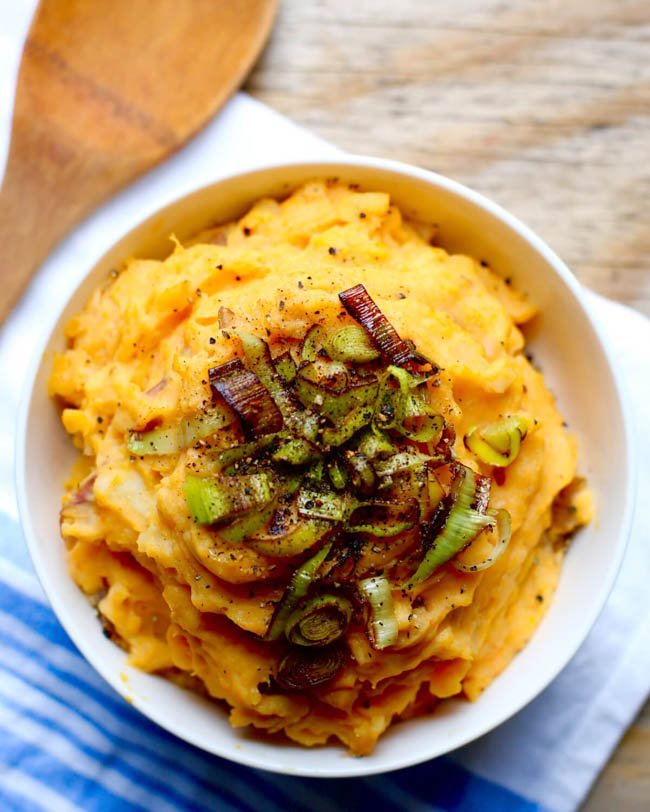
    Our perfect side dish this year: Creamy Butternut Squash Mashed Potatoes. It’s the perfect combination because the butternut squash adds a subtle sweetness and healthy twist on a classic recipe.

    Butternut squash is the perfect touch in those cooler, fall months. It is usually a beige colored gourd with a similar taste to sweet potato.  This will give the potatoes smooth and creamy texture with some added flavor. Butternut squash is also full of important nutrients that fall in the carotenoid family.  Carotenoids are red/orange veggies that are a fantastic source of magnesium, potassium, vitamin A, vitamin C, and other antioxidants.
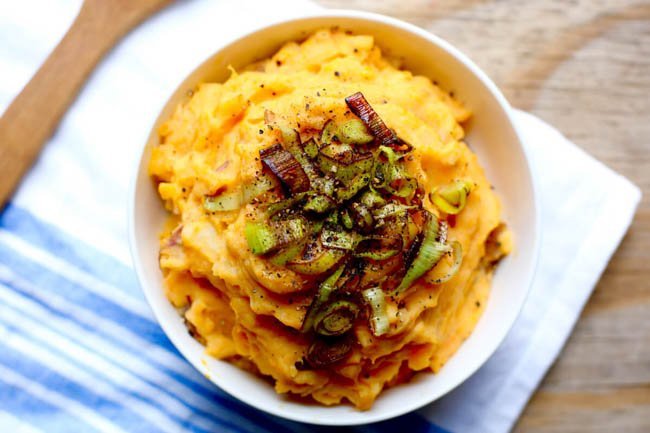
    To whip these dreamy potatoes up, start by boiling the potatoes with the skins on in a pot of water for 25-30 minutes, or until they are tender. Pro tip: leaving skin on the potato boosts the fiber content, which is a total plus! In another pot, boil the butternut squash for 15 minutes, or until tender.  Next, in a bowl, combine the potatoes, butternut squash, cream cheese, and garlic powder, and salt to taste. Using a pestle or fork, mash all the ingredients together until smooth and creamy.  Next, we’ll get to the leek topping. Heat up the olive oil, and add the leeks and soy sauce. Sauté for 3-4 minutes. Add the leek topping to the mashed potatoes, and finish off with ground black pepper. 
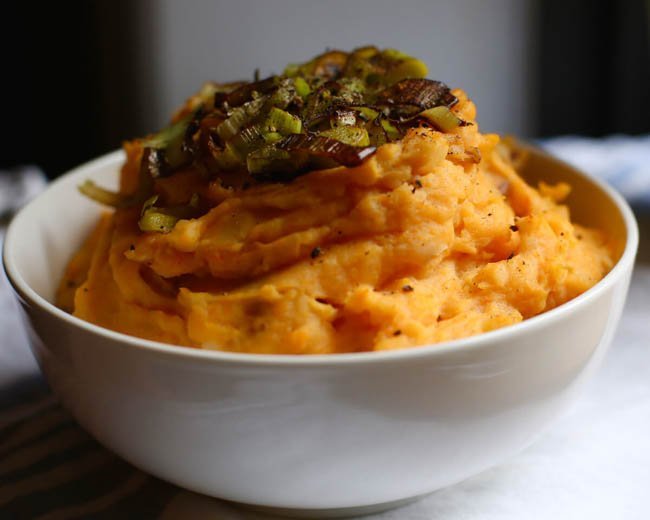
    So now we want to hear from you. What do you think about our tasty addition of butternut squash to your traditional mashed potatoes? Let us know what you think in the comments below!

    Print
    Creamy Butternut Squash Mashed Potatoes
    Servings: 4
    Ingredients
    • 4 medium potatoes, peeled and quartered
    • 1 cup butternut squash, peeled and cubed
    • 2 tablespoons cream cheese
    • 1 teaspoon garlic powder
    • Salt and pepper to taste
    For leek topping
    • 1 teaspoon olive oil
    • 1/4 cup leeks, sliced
    • 1/4 teaspoon soy sauce
    Instructions
    1. Start by boiling the potatoes in a pot of water for 25-30 minutes, or until tender.

    2. In another pot, boil the butternut squash for 15 minutes, or until tender
    3. Drain the water from both pots
    4. In a bowl, combine the potatoes, butternut squash, cream cheese, and garlic powder. Salt to taste
    5. Using a pestle or fork, mash all the ingredients together until smooth and creamy
    6. Next, we'll get to the leek topping. Heat up the olive oil, and add the leeks and soy sauce. Sauté for 3-4 minutes
    7. Add the leek topping to the mashed potatoes, and finish off with ground black pepper. Enjoy!

    Filed Under: Appetizers, Salads, Sides

    South Indian Squash Curry

    November 15, 2016 by Wendy 7 Comments

    We have a confession to make…

    We have never tried a meal delivery service. Not sure how we missed this revolutionary new way of cooking, but we did.

    So when Blue Apron reached out to us to see if we wanted to give their vegetarian box a try, we jumped at the chance.

    We started our meal delivery adventure by placing our order on the Blue Apron website. Vegetarian box? We’ll take one, please. We received the order the same week we placed it – within 5 days. On the menu: South Squash Indian Curry, which basically melts in your mouth. But we’ll get to the recipe later.

    When we opened our box, we were excited to see that there were instructional materials detailing exactly how to do each recipe, which is perfect for the visual learner in all of us. And for those who don’t have a lot of experience in the kitchen, there are instructional videos on the site that break things down even further.

    Overall, the recipes were super simple, which we loved. Our motto is that healthy eating DOESN’T have to be complicated – or intimidating. The fact that these recipes were easy enough for a 12-year-old to follow was a major win.

    All in all, the meals took less than 30 minutes to prepare from start to finish. We don’t like spending hours in the kitchen. (Well maybe on thanksgiving, but that’s it). For a weeknight dinner recipe, 30 minutes is the max amount of time we want to invest.

    In the end, the meals were absolutely delicious and seriously filling. Although we prefer traditional way of cooking, this is a great option for anyone who wants to take a break from all of the prepping, shopping and planning that comes with making healthy meals. It’s also good for folks who want to add more recipe ideas to their repertoire. 

    And for those who want even more deets about Blue Apron, here you have it.

    • Using this service is a fun way to discover exciting, seasonal recipes. A lot of time’s our patients get stuck in a rut, and this can help give you more healthy recipes for your repertoire that are absolutley delicious.
    • Another bonus is that recipes never repeated in the same year. If you are someone who likes variety, we like the fact that you get it with this subscription.
    • Most recipes have about 500-800 calories per serving. We generally recommend an average of 400-600 calories for MOST people for breakfast, lunch and dinner (individually, not combined).
    • We love sustainable eating, and one of the nice things about this meal delivery service is that all of the ingredients are perfectly pre-measured, so there’s no waste. 
    • Free delivery nationwide. Need we say more?
    • You can also choose a delivery day that best fits your schedule.
    • Also! Ingredients arrive in a refrigerated box, so food stays fresh even if you’re not home when we deliver. Hello late night at the office.

    If you try this out, let us know in the comments below how you like it OR tag us on instagram @foodheaven. We’d love to hear your thoughts and see your creations. 

    Print
    South Indian Squash Curry
    25 mins
     
    Servings: 2
    Ingredients
    • ¾ Cup Jasmine Rice
    • 1¾ Cups Light Coconut Milk
    • 4 Cloves Garlic
    • 1 Butternut Squash
    • 1 Stalk Celery
    • 1 Bunch Cilantro
    • 1 Shallot
    • 1 1- Inch Piece Ginger
    • 2 Teaspoons South Indian Curry Spice Blend, Cumin Seeds, Brown Mustard Seeds, Cayenne Pepper & Ground Turmeric
    Instructions
    1. Wash and dry the fresh produce. Cut off and discard the ends of the squash; using a knife, carefully peel. Separate the neck and bulb of the squash; halve the bulb lengthwise. Using a spoon, scoop out and discard the pulp and seeds; medium dice the squash.
    2. Peel and mince the garlic and ginger. Peel and thinly slice the shallot. Small dice the celery. Pick the cilantro leaves off the stems; discard the stems.
    3. In a medium pot, combine the rice, a big pinch of salt and 1½ cups of water; heat to boiling on high. Once boiling, cover and reduce the heat to low. Cook 12 to 14 minutes, or until the water has been absorbed and the rice is tender. Remove from heat and fluff the cooked rice with a fork.
    4. While the rice cooks, in a large, high-sided pan (or pot), heat 2 teaspoons of olive oil on medium-high until hot. Add the squash and season with salt and pepper. Cook, stirring occasionally, 6 to 8 minutes, or until lightly browned and slightly softened.
    5. To the pan, add the garlic, ginger and as much of the spice blend as you’d like, depending on how spicy you’d like the dish to be; season with salt and pepper. Cook, stirring frequently, 30 seconds to 1 minute, or until fragrant. Add the shallot and celery; season with salt and pepper. Cook, stirring occasionally, 3 to 5 minutes, or until softened and fragrant.
    6. Add the coconut milk (shaking the can just before opening) to the pan; season with salt and pepper. Reduce the heat to medium and simmer, stirring occasionally, 10 to 12 minutes, or until thickened. (Be careful not to boil, as the coconut milk may separate.) If the curry seems too thick, gradually add up to ¼ cup of water to achieve your desired consistency. Remove from heat and season with salt and pepper to taste.
    7. Divide the cooked rice and finished curry between 2 dishes. Garnish with the cilantro. Enjoy!

    FTC: This post was sponsored by our friends at Blue Apron.

    Filed Under: Main Courses

    Our Morning & Nightly Routine

    November 8, 2016 by Wendy 9 Comments

    Today we’re talking about our routines- what we do when we wake up, and how we wind down as bedtime approaches. Having a routine in place helps to set your day up for success. You feel good, in control, and are better able to manage healthy eating and lifestyle changes. This also results in improved sleep and energy levels. Below is an outline of our daily routine. Listen in to get the more thorough and interactive version! Hopefully some of the things we incorporate into our routine will be helpful for when you develop your very own routine. Have a solid routine you find helpful? Drop a line in the comments below and let us know! 


    Jessica’s AM Routine:

    • Wake up using sleep cycle app (https://www.sleepcycle.com/)
    • Drink 4 glasses of water with lemon
    • Make breakfast: rotate between either a smoothie or oatmeal on weekdays
    • Workout: If working out, then i’ll have something before like an apple and some nuts and a smoothie after 
    • Head to work 
    Jessica’s PM Routine:
     
    • Do body stretches and a neck massage
    • Brush teeth & wash my face
    • Listen to a podcast or audiobook, or read a book
    • Lights off, phone ALWAYS on silent
    • Set alarm
    • Earplugs in, sleep eye mask on, hair wrapped
    • Occasionally may rub essential oils (lavender) on my neck
    • Go to bed by 930pm

    Wendy’s AM Routine:

    • Wake up to my relaxing Samsung morning flower alarm after having around 8 hours of sleep
    • Read a passage from Don’t Sweat the Small Stuff, and read a passage from Osho’s 365 Daily Meditations– (takes less than 5 minutes!) 
    • Stretch for like 1 minute 
    • Brush my teeth, floss, jump in the shower
    • Drink 2-3 cups of water- I have mason jars placed all over the house 
    • Make breakfast- either homemade granola with almond milk or an egg sandwich avocado or smoked salmon
    • Pack lunch, tea, snacks
    • Go to work 

    Wendy’s PM Routine: 

    • Shower when I get home since I usually go to the gym in the evening
    • Have a light dinner
    • Light candles
    • May listen to a podcast or talk on the phone 
    • Wash face, slap some jojoba oil on there, brush teeth, floss
    • Set alarm, silence phone, all lights off- and go to bed by 10pm (on a good day)

    Filed Under: Podcast

    Dietitian Spotlight: McKel Hill

    September 21, 2016 by Wendy 1 Comment

    Nutrition Stripped is far more than a blog, it’s a way of living. As a dietitian nutritionist, McKel shares how you can take your health to the next level by optimizing the way you think about food and your lifestyle. Through her amazing site, she shows you that eating nourishing foods and living a whole-lifestyle can transform your well-being on all levels; nourishing your body from inside your cells so it radiates out. 

    What’s your favorite part about being a dietitian?

    Helping people. There’s nothing more gratifying and inspiring than hearing a client share how much their time with me has transformed their life, what life skills they’ve learned, and how they’ve integrated their new lifestyle with family and friends. I know how it feels to feel imbalanced and not my optimal self, so anytime I can help people reach optimal health, or even slightly better health depending on where they start from, is incredible!

    Describe what your typical week looks like.

    I try to have a “typical” week as much as possible, but with my line of work juggling many projects and streams in my business it’s far from typical or routine — which is something I’m grateful for! I keep myself on track by compartmentalizing my work. For example one day is dedicated to my nutrition coaching clients, another to blogging or contributing writing or press, another to recipe testing and photography, another to admin or meeting with my team, another for pure creative time, another for researching my profession, and another for meetings. It’s always busy, but I’m grateful for all of it.

    How do you find balance between work life and personal life?

    I try to limit work to about 40 hours a week, but there are many times during the year where I work about 60+ a week depending on how busy the season is. It all evens out in the end but in order to find balance (and maintain my sanity), I always follow my Morning Routine and I share an entire list of daily practices on how to find balance with life in the Nutrition Stripped Cookbook. Also, surrounding myself with friends and loved ones keeps me grounded and constantly reminds me what my end goal is = happiness! Happiness, so that I can give back to the NS community and what I do 100% with a full heart.

    What are 3 foods you can’t live without?

    Raw cashews, avocados, and spirulina! Healthy fats, vitamins, minerals, protein, antioxidants, what more do you need?!


    For more on McKel Hill, check out her website here and make sure you follow her on Instagram here! 

    Filed Under: Dietitian Spotlight

    Diabetes Management Part 2

    September 1, 2016 by Wendy 2 Comments

    Since diabetes management is such a loaded topic, we broke things up into 2 parts. Last month, we spoke about risk factors for diabetes, signs/symptoms, getting a proper diagnosis, and the process of self-monitoring glucose (blood sugars) at home. This month, we’ll be go over diabetes-related complications, how to cope if you’re diagnosed with diabetes, medication use, and lifestyle changes.
    Our special guest, Margarette Edouard, is a Certified Diabetes Educator (CDE) & Registered Dietitian (RD) and will be sharing all of her expertise with us. Below is a brief overview of the topics discussed! So you have diabetes- but there so many things you can do to get it under control! This way you’re at a lower risk for complications, you feel good, and you are living your best life.
    1. Nutrition 
    We’ll start with carbohydrates, since they have the most influence on your BG compared to proteins and fats. Having diabetes doesn’t mean you need to eliminate all carbs. Many carb-containing foods are nutrient-rich and have many health benefits.What you want to do is practice portion control with and limit/eliminate refined carbs. Healthy carb-containing options include fruit, sweet potato and other tubers, beans, quinoa, brown rice, oatmeal, whole grains, and more. What you want to reduce or eliminate are refined grains- white bread, white rice, white pastas, sweetened beverages (even if made with honey or maple syrup), juices- even if they have no sugar added, cakes, pastries, and cookies.When incorporating carbs into a meal use the myplate method, making half the plate non-starchy vegetables (think spinach, collards, Brussel sprouts, eggplant, okra, tomatoes- not corn, potato, and sweet peas)Then have ¼ of the plate with your protein, and the other ¼ of the plate with carbohydrate. I generally recommend having only 1 carb choice per meal- so it’s tortilla or rice, bread or pasta, rice or potatoes. Latinos are big on beans and rice together, and as I mentioned, beans do have carbs. So what I would recommend is if having both, make sure the beans and rice fit onto that ¼ section of the 8-9” plate.
    Let’s talk about what that would look like:

    • You could have ½ plate of sautéed kale with ½ cup brown rice and a side of baked salmon
    • You could have 1 small roasted potato with a chicken breast and 1-2 cups of sautéed broccoli
    • You could have 2 scrambled eggs with 2-3 corn tortillas (33g) and ¼ avocado and/or 1c spinach
    • You could have bean soup made with ¾ cup of cooked beans, and packed with 2 cups of non-starchy vegetables.

    Note that you don’t have to include carbs for every meal- let’s say for dinner you just want a green salad topped with tuna, chicken, or boiled eggs, that’s totally fine too.

    Now with coming up with a meal plan, it really should be individualized and include foods that you enjoy- in a balanced and nutritious way.

    Other things you can do- watch the sodium, not just salt added, but all the salt in processed foods. They can contribute to heart disease and HTN which can worsen diabetes symptoms

    Watch your portions- especially if you are overweight. Have plenty of non-starchy vegetables with meals, which are packed with fiber and help keep you full. That way, you don’t overdo it on the carbs.

    Fiber- fiber slows down CHO digestion, and it helps push things through the GI tract. All unrefined plant-based foods have fiber (fruit, vegetables, whole grains, seeds, nuts) etc. For someone not taking in much fiber, I recommend you add fiber boosters- things like flaxseed, chia seeds, or nuts, to your cereals or smoothies for an extra boost.

    Now with fruit, you may be thinking- well fruits are sweet, so no fruits. Not the case. Fruits are super nutritious- you just don’t want to overdo it. Stick to 2 servings a day- 1 apple and 1 orange, 1 cup strawberries and ½ medium banana. Try to enjoy with some protein- nut butter, plain yogurt, nuts

    Watch your fats- include healthy fats on your plate- nuts, seeds, nut butters, avocados, fish, and vegetable oils. Limit saturated fat sources- creams, butters, ice cream, full-fat milk, beef, bacon- people with DM are at a higher risk for heart disease so limiting your saturated fat intake can reduce your risk for heart attack of stroke

    These recommendations are not exclusive to people with diabetes- these are guidelines for anyone who wants to eat healthy and well-balanced.

    Important to note- these recommendations are not set in stone. Personal preference, economic, culture, health beliefs, activity levels and weight goals should all be considered when developing a meal plan. If you’re very active, you may benefit from having more CHO’s as part of your diet. If you have uncontrolled diabetes, tighter control may be needed with food choices. There are so many things to consider and an RD can help you do this.

    2. Physical activity (importance of healthy weight, what kind of exercises, how often, special considerations)

    3. Manage stress (cortisol and other stress hormones trigger spikes in sugar)- tap into support network, meditation, working out, deep breathing

    4. Medication adherence (taking medications as indicated, working with primary care provider to adjust)

    5. Attending appointments with your medical team (PCP, RD, CDE, pharmacist, endocrinologist, podiatrist, ophthalmologist, dentist, therapist)

    Questions from our listeners!

    1. Can u reverse type 2 diabetes?
    2. Does everyone with type 2 diabetes end up on insulin?
    3. Does everyone with type 2 diabetes need medication?
    4. Can people with diabetes drink alcohol?

    (listen in for the replies from Margarette!) 


    Filed Under: Podcast

    • « Go to Previous Page
    • Page 1
    • Interim pages omitted …
    • Page 81
    • Page 82
    • Page 83
    • Page 84
    • Page 85
    • Interim pages omitted …
    • Page 96
    • Go to Next Page »

    Primary Sidebar

    Search

    Let’s Connect

    Meet Wendy & Jess

    Registered Dietitians & BFF's. We're probably busy eating right now.

    Subscribe to our Podcast

    food heaven podcast

    Podcast Hookup Codes

    food heaven podcast hookup codes

    Meet Wendy & Jess

    Registered Dietitians & BFF's. We're probably busy eating right now.

    • Diabetes Digital
    • Our Story
    • Recipes
    • Resources
    • Articles
    • Contact
    • Policies
    © Food Heaven Made Easy
    In order to provide you with the best service, our website uses cookies. By continuing to browse the site you are agreeing to our Privacy Policy I consent
    Privacy Policy

    Privacy Overview

    This website uses cookies to improve your experience while you navigate through the website. Out of these cookies, the cookies that are categorized as necessary are stored on your browser as they are essential for the working of basic functionalities of the website. We also use third-party cookies that help us analyze and understand how you use this website. These cookies will be stored in your browser only with your consent. You also have the option to opt-out of these cookies. But opting out of some of these cookies may have an effect on your browsing experience.
    Necessary
    Always Enabled
    Necessary cookies are absolutely essential for the website to function properly. This category only includes cookies that ensures basic functionalities and security features of the website. These cookies do not store any personal information.
    Non-necessary
    Any cookies that may not be particularly necessary for the website to function and is used specifically to collect user personal data via analytics, ads, other embedded contents are termed as non-necessary cookies. It is mandatory to procure user consent prior to running these cookies on your website.
    SAVE & ACCEPT